Not every shipment needs a full container. Many businesses move smaller volumes, test new markets, or manage fluctuating demand. In those cases, paying for unused container space simply does not make sense. That is where LCL shipping becomes your best option.
Understanding what LCL means in shipping, how LCL containers operate, and how costs are structured helps businesses make smarter shipping decisions. Knowing when to choose LCL over FCL enables better cost control, leaner inventory management, and greater supply chain flexibility. This guide outlines the key tradeoffs to evaluate before booking and provides a clear, practical perspective on all the factors that shape an LCL shipment decision.
Less than container load (LCL) meaning
LCL, or Less than Container Load, refers to an ocean freight shipping method where your cargo does not fill an entire container and instead shares space with other shipments moving to the same destination.
In other words, you pay only for the volume your cargo occupies, rather than the cost of a full container. This makes LCL a practical solution for smaller or variable shipments.
FCL (Full Container Load) shipping, on the other hand, represents the single-shipper counterpart to LCL. With FCL, a single shipper uses the entire container, regardless of whether it is fully utilized. Both LCL and FCL are used exclusively in ocean freight transport.
Groupage shipments and related terms
LCL shipments are also referred to as groupage shipments, particularly in international logistics. The term reflects the grouping of multiple shipments into one container for transport.
You may also encounter references to loose cargo loads, which describe goods that are not palletized. Loose cargo may consist of individual cartons or irregularly shaped items that cannot be easily palletized or containerized. These terms are frequently associated with LCL shipping documentation and handling.
How LCL shipping works
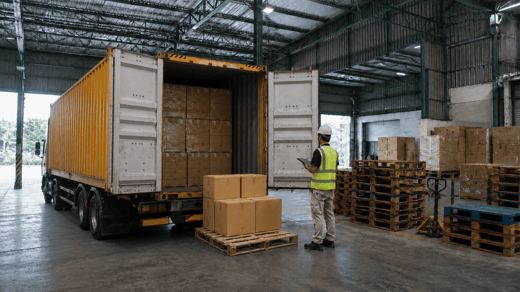
In an LCL shipment, multiple consignments from different shippers are consolidated into a single container at the origin. This consolidation typically takes place at a Container Freight Station (CFS), where cargo is grouped based on destination and sailing schedule.
Once loaded, the container moves as a single unit across the ocean. Upon arrival, it is transferred to another CFS at the destination, where shipments are separated and released for final delivery. This process allows container space to be used efficiently while giving smaller shippers access to global trade lanes.
Because LCL shipments share container space, they are especially useful for businesses shipping irregular volumes, seasonal products, or partial replenishments. Retailers, manufacturers, automotive suppliers, and eCommerce brands commonly rely on LCL to maintain supply chain flexibility without overcommitting to container capacity.
Benefits of LCL freight shipping
LCL shipping offers distinct advantages for businesses that do not consistently move full-container volumes:
- Cost efficiency for smaller shipments: By paying only for the space used, LCL avoids the cost of unused container capacity and is typically far more economical than air freight.
- Operational flexibility: Businesses can ship smaller quantities more frequently, adjusting volumes as demand rises or falls without committing to a full container.
- Lower inventory pressure: Shipping smaller loads helps reduce warehousing needs, minimize excess inventory, and improve cash flow.
- Access to global routes: LCL logistics enables participation in international trade without the volume requirements of FCL shipping.
For companies balancing cost, speed, and flexibility, LCL often provides the right middle ground.
Drawbacks of LCL logistics
Despite its advantages, LCL is not the right solution for every shipment:
- Longer transit times: Consolidation and deconsolidation add handling steps that typically extend transit time compared to FCL.
- Higher cost per cubic meter: While cheaper for small volumes, LCL is more expensive per CBM than FCL and can become cost-inefficient as volume increases.
- Greater exposure to delays: Because multiple shipments share one container, customs delays or documentation issues affecting one shipment can impact others.
- Increased handling risk: LCL cargo is handled more frequently, which slightly increases the risk of damage or loss compared to sealed FCL containers.
Understanding these tradeoffs will help you decide whether LCL fits your shipment profile.
LCL shipping costs explained
LCL shipping costs are primarily calculated based on volume, measured in cubic meters (CBM). Weight is also considered, but in ocean freight, volume typically plays a larger role because container space is the limiting factor.
An LCL quote generally includes pickup from the origin location, handling and consolidation at the origin CFS, ocean freight for the main leg of the journey, deconsolidation at the destination CFS, and final delivery to the receiving warehouse. While the ocean freight portion is often not the most expensive component, handling and terminal charges can significantly affect the total cost.
Minimum allotment in LCL shipping
Most LCL shipments are subject to a minimum chargeable volume, typically one cubic meter (1 CBM). Even if your shipment occupies less space, freight forwarders apply this minimum to account for consolidation, handling, and administrative costs. Understanding this minimum is essential when estimating total LCL shipping costs.
Additional LCL fees to consider
Certain shipments may incur additional charges beyond standard LCL costs. Amazon FBA shipments, for example, require strict labeling and palletization. While labeling and palletizing at origin is often more cost-effective, suppliers must follow Amazon’s specifications precisely to avoid rework fees at the consolidation center.
All imports into the United States also require a customs bond. Businesses shipping infrequently may choose a single-entry bond, while frequent importers typically benefit from an annual bond. Duties and taxes are assessed upon arrival, but estimating them in advance allows for more accurate landed cost calculations.
How to get accurate quotes for LCL shipping
Getting accurate quotes for LCL shipping requires full visibility into origin, minimum rates, and destination charges, not just the freight rate. The following list may help you:
- Provide exact cargo dimensions and weight, including total CBM, cartons, and palletization details.
- Share complete origin and destination addresses, including whether delivery is to a port, warehouse, or fulfillment center.
- Confirm cargo readiness and shipping timeline, as cutoff dates and sailings affect pricing.
- Clarify the Incoterms and scope of service, so all pickup, CFS, and delivery costs are included.
- Disclose any special requirements, such as hazardous materials, Amazon FBA labeling, or customs constraints.
LCL vs FCL: What is the difference between FCL and LCL shipments?
|
Factor
|
LCL (Less than Container Load)
|
FCL (Full Container Load)
|
|
Container usage
|
Shared container space with other shippers
|
The entire container is used by one shipper
|
|
Typical shipment size
|
Small to medium volumes that do not fill a container
|
Large volumes that can fill (or nearly fill) a container
|
|
Cost structure
|
Pay only for the space used (per CBM)
|
Pay a flat rate for the full container
|
|
Cost efficiency
|
More economical for smaller shipments
|
Lower cost per unit when the container is fully utilized
|
|
Flexibility
|
High flexibility for changing or seasonal volumes
|
Best for steady, predictable shipping volumes
|
|
Handling
|
More handling due to consolidation and deconsolidation
|
Less handling with sealed, single-shipper cargo
|
|
Transit time
|
Slightly longer due to consolidation steps
|
Generally faster and more direct
|
|
Risk profile
|
Higher exposure to delays from other shipments
|
Lower risk of delay or damage
|
|
Best use case
|
Market testing, partial replenishment, variable demand
|
High-volume, regular shipments with stable demand
|
Booking process for LCL shipments
Arranging an LCL shipment typically involves the following steps:
- Selecting a logistics partner with proven experience in LCL consolidation and destination handling.
- Coordinating pickup and sailing schedules to align cargo readiness with consolidation cutoffs.
- Managing consolidation and documentation to ensure cargo moves smoothly through origin and destination CFS facilities.
With the right logistics provider, LCL bookings remain predictable and efficient, even across complex international routes.
LCL shipping with VinWorld
LCL shipping works best when it is managed with precision, visibility, and local expertise at both origin and destination. VinWorld supports LCL shipments end-to-end, coordinating consolidation, managing costs, and keeping you informed at every stage so there are no surprises.
Let us design an LCL solution that fits your cargo, your timelines, and your business priorities. Request a quote
FAQs about LCL
What does LCL mean for shipping?
LCL means Less than Container Load. LCL shipping is an ocean freight method where multiple shipments share space in one container.
Is LCL the same as LTL?
No. LCL applies to ocean freight, while LTL (Less than Truckload) applies to domestic ground transportation.
Is LCL shipping cheaper?
For small volumes, LCL is usually cheaper than FCL. For larger volumes, though, FCL often provides better value.
How long does LCL shipping take?
Transit times vary by route but are generally longer than FCL due to consolidation and deconsolidation steps.
What documents are required for an LCL shipment?
An LCL shipment typically requires a complete set of commercial and shipping documents to ensure smooth consolidation, customs clearance, and delivery. These usually include a shipping quote, commercial invoice, packing list, bill of lading, booking confirmation, and shipper’s letter of instruction. Depending on the cargo and destination, additional documents such as a certificate of origin, material safety data sheet, or letter of credit may also be required.
Why is LCL shipping so expensive?
LCL shipping often costs more per cubic meter because it involves additional handling, consolidation, and deconsolidation at both origin and destination.


Comments