Choosing the right container strategy for your ocean freight can significantly impact cost, transit time, and operational risk. One of the most common and often misunderstood terms you will encounter is FCL. Understanding the term and when this method of shipping outperforms alternatives like LCL is essential for making informed logistics decisions.
This guide explains:
- what FCL is,
- how FCL shipping works in practice,
- typical costs,
- container types,
- and real-world use cases.
FCL shipment meaning
FCL stands for Full Container Load.
In shipping, FCL describes ocean freight for cargo volumes large enough to use an entire container – typically a 20 or 40 feet external container length unit. Unlike shared options, an FCL container is reserved for a single shipper from origin to destination. The container is loaded and sealed at the shipper’s facility (or a designated warehouse) and remains sealed until it reaches the consignee.
What is FCL shipping?
FCL shipping refers to sea freight where one shipper books and pays for the entire container, regardless of whether it is filled to maximum capacity. The container is not shared with other cargo.
By contrast, LCL (Less-than-Container Load) consolidates shipments from multiple shippers into one container, with each paying for only the space used. LCL can be cost-effective for smaller volumes, but it introduces additional handling, consolidation, and risk.
In simple terms:
- FCL = one shipper, one container, sealed end-to-end
- LCL = multiple shippers sharing container space
Ocean FCL vs. LCL
FCL or LCL, which is better? LCL is typically better suited for smaller volumes with flexible timelines, while FCL is often the right choice for larger, time-sensitive, or high-value shipments. In practice, the decision is influenced by several factors, including:
- cargo value and fragility,
- total volume and weight,
- delivery deadlines,
- available warehouse space
- unloading capability,
- your risk tolerance.
Ultimately, understanding the difference between FCL and LCL is less about choosing a label and more about selecting the shipping model that best supports your supply chain performance each time.
Discover your options
The FCL shipping process with examples
FCL transport may sound complex, but a qualified ocean freight forwarder like VinWorld can coordinate the entire journey for you. From booking through final delivery, the process typically takes 30–45 days, depending on route and service.
Key FCL process steps
- Booking and carrier selection
- Documentation and compliance
- Container loading and export haulage
- Export customs clearance
- Ocean transportation
- Import customs clearance
- Final inland delivery
Now let’s see some examples:
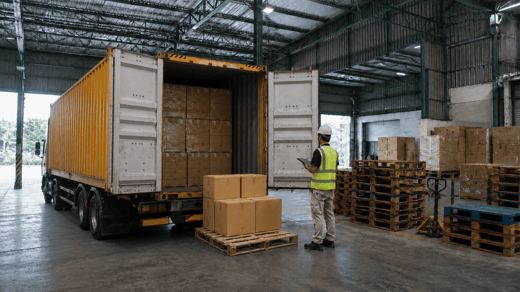
A US importer ships 22 pallets of furniture from Vietnam in a 40’ container, coordinated by a freight forwarder. The container is loaded and sealed at the factory, then moved end-to-end under a single booking, reducing handling, simplifying customs clearance, and minimizing damage risk throughout the shipment.
A consumer electronics brand ships 18 pallets of finished goods from China in a 40’ High Cube container to a US West Coast port. By moving all inventory in one container, the brand avoids consolidation delays, simplifies customs clearance, and ensures the full product launch arrives market-ready in one coordinated delivery ahead of peak demand.
FCL pros & cons
Pros of FCL
- Reduced handling: No consolidation or deconsolidation with other cargo
- Lower damage risk: Factory-sealed containers with limited exposure
- Cost efficiency at scale: Flat container pricing lowers per-unit cost
- Faster transit: Fewer operational touchpoints than LCL
- Security: Lower theft and tampering risk
💡 From an operational standpoint, FCL freight offers simplicity, predictability, and control.
Cons of FCL
- Higher cost for small volumes: Underutilized containers raise per-unit cost
- Inventory pressure: Requires storage space and cash tied up in stock
- Operational demands: Equipment and labor needed to unload full containers
- Fee exposure: Demurrage, detention, and repositioning fees apply fully to one consignee
💡For shipments under ~13 CBM, LCL may still be the more economical option.
FCL container types
FCL container types and dimensions
|
Container Type
|
Inside Dimensions (L×W×H)
|
Capacity
|
Max Weight
|
|
20’ Standard
|
5.90 × 2.35 × 2.39 m
|
33.2 m³
|
21,770 kg
|
|
40’ Standard
|
12.04 × 2.35 × 2.39 m
|
67.7 m³
|
26,780 kg
|
|
40’ High Cube
|
12.01 × 2.33 × 2.69 m
|
76.28 m³
|
26,512 kg
|
💡 Dry containers handle nearly 90% of global cargo, including machinery, furniture, paper, steel, and packaged goods.
Refrigerated (Reefer) containers
These containers are used for perishables such as food, pharmaceuticals, and flowers:
- 20’ Standard Reefer: −30°C to +30°C
- 40’ HC Reefer: −35°C to +30°C
- Super Freezer: down to −60°C
Specialized container types
- Open top containers: Overheight cargo, top loading, covered with removable tarpaulin.
- Platform containers: Heavy, oversized loads with no walls or roof.
- Flat rack containers: Used for out-of-gauge cargo. Features collapsible or fixed sides.
- ISO tank containers: Safe liquid and gas transport, multiple standardized sizes
Specifications vary by manufacturer and carrier.
How much does FCL cost?
With FCL shipping, pricing is based on a flat rate per container, not per cubic meter. As shipment volume increases, FCL typically becomes more cost-effective than LCL by lowering the per-unit cost and reducing consolidation-related charges. For growing or time-sensitive shipments, this pricing model delivers greater predictability and budget control.
FCL costs are influenced by factors such as General Rate Increases (GRIs), peak season surcharges – usually between August and November – holiday disruptions like Chinese New Year or Golden Week, and route or port selection, especially in congested markets.
Additional charges may include:
- customs clearance,
- fuel adjustments (BAF),
- canal transit fees,
- terminal handling charges,
- inland delivery,
- congestion surcharges.
Managing these variables effectively requires planning and a freight partner committed to transparent, end-to-end pricing.
FCL Incoterms and cost responsibility
In FCL shipping, Incoterms play a critical role in defining cost, risk, and accountability at every stage of the journey. Many shippers underestimate how much FCL incoterms influence the true landed cost and where exposure begins. Getting this wrong can quickly turn a well-priced FCL shipment into an expensive one.
For example, under FOB (Free On Board), the seller is responsible until the container is loaded onto the vessel, while the buyer becomes accountable for control of ocean freight, insurance, and destination charges.
With CIF (Cost, Insurance, and Freight), the seller covers ocean freight and insurance, but responsibility still transfers at the port of loading, leaving buyers exposed to destination costs and delays.
DAP (Delivered at Place) shifts most responsibility to the seller, including inland delivery, but requires careful coordination to avoid customs and unloading issues.
Understanding how incoterms affect FCL transport clarifies who pays, who manages risk, and where handoffs occur, ensuring cleaner execution, fewer disputes, and predictable outcomes.
Common mistakes to avoid with FCL shipments
Many issues in FCL shipping are not caused by the ocean transit itself, but by avoidable execution gaps.
One common mistake is booking an FCL shipment without properly utilizing container space, which drives up per-unit costs. In addition, incomplete or inaccurate documentation can delay customs clearance and quickly trigger demurrage fees. Moreover, missed delivery appointments, especially at congested ports or FBA warehouses, often result in detention charges. Finally, inadequate unloading capacity at the destination can stall container return and compound costs. Reliable FCL services focus on planning each handoff in advance, ensuring FCL freight moves efficiently from origin to final delivery without costly surprises.
FCL shipping with VinWorld
FCL shipping works best when every step is planned, visible, and actively managed. VinWorld supports FCL services with end-to-end coordination, transparent pricing, and proactive communication, so your containers move on schedule, without surprises, from origin to final delivery. Request a quote
FAQs about FCL
What are FCL and LCL in shipping?
FCL and LCL are both ocean freight shipping methods. FCL (Full Container Load) means one shipper uses an entire container, while LCL (Less-than-Container Load) combines multiple shipments in one container, sharing space, costs, and handling.
What does 40 FCL mean?
40 FCL refers to a shipment booked as a full 40-foot container, reserved entirely for one shipper. The container is loaded, sealed, and transported without sharing space with other cargo.
What does 20 FCL mean in shipping?
20 FCL means a shipment moving in a full 20-foot container, regardless of whether the container is completely filled. The shipper pays a flat container rate and benefits from simplified handling, reduced risk, and end-to-end container control.
What is the difference between LTL and FCL?
LTL (Less-Than-Truckload) applies to domestic trucking, where freight shares trailer space with other shippers. FCL (Full Container Load) applies to ocean freight, where one shipper uses an entire container, avoiding shared handling and consolidation delays.
Is FCL faster than LCL shipping?
Yes. FCL shipping is generally faster than LCL because the container is not shared, eliminating consolidation and deconsolidation steps. In an ocean FCL vs LCL comparison, fewer handling points mean more predictable transit times and reduced risk of port or warehouse delays.
Can you ship partially filled containers as FCL?
Yes. FCL means you book the entire container for your shipment, so you can ship it even if it is not fully packed. You pay the flat container rate, but you keep exclusive use of the space, often to protect high-value goods, meet tight timelines, or avoid shared-container handling.
What services are included in FCL freight forwarding?
FCL services typically cover carrier booking, documentation management, export and import customs clearance, ocean transport, and inland delivery coordination. Effective FCL freight and FCL transport also include proactive tracking and issue management to keep shipments moving without disruption.


Comments