
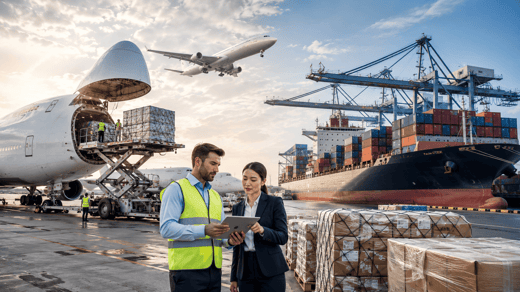
Global trade depends on one core capability: moving goods reliably across borders at scale. Ocean freight, also known as sea freight, makes that possible. From raw materials to finished consumer products, freight by sea supports supply chains that span continents, industries, and economies.
Understanding how ocean freight works, when to use it, and how to manage it effectively helps businesses create more reliable and cost-effective goods movement.
This guide explains how the ocean freight forwarding process works, the different shipment types, pricing factors, advantages and disadvantages of freight by sea, and how to prepare goods for safe and efficient shipping.
Key Takeaways
- Ocean freight, also called sea freight, is the transportation of goods by cargo vessel across international waters, and it is the most widely used method for moving large volumes between countries.
- It is slower than air freight, with transit times often 30 to 60 days, but far cheaper per unit, which makes it the go to for bulk, heavy, or high volume cargo.
- Shipments move as FCL (a full container for one shipper) or LCL (cargo from multiple shippers sharing a container), with FCL offering lower risk and LCL suiting smaller loads.
- Incoterms like FOB, EXW, and DDP decide who pays and who carries risk at each stage, and rates shift with fuel, demand, port congestion, and geopolitics.
- Sea freight wins on capacity, cost, and cargo flexibility, but comes with longer transit, more handling, and less schedule certainty.
What is ocean freight?
Ocean freight is the transportation of goods by cargo vessel across international waters. It is the most widely used method for moving large volumes of goods between countries and continents.
In practical terms, ocean freight logistics rely on scheduled shipping routes, global port infrastructure, standardized containers, and coordinated documentation. Goods are typically loaded into 20-foot or 40-foot containers, secured on container ships, and transported port-to-port over the open ocean.
What is the meaning of ocean freight?
The meaning of ocean freight refers not only to transport by sea, but to the entire logistics framework supporting that movement: vessel space, port operations, customs clearance, inland transportation, and compliance management.
Ocean freight vs. air freight
Ocean freight is slower than air freight; transit times often range from 30 to 60 days, depending on origin, destination, and routing. However, it scales exceptionally well. As shipment size increases, the cost per unit drops, making sea freight the preferred option for bulk, heavy, or high-volume cargo.
In short: While air freight offers speed, ocean freight transportation delivers efficiency, capacity, and cost control for international shipping.
Sea freight vs. ocean freight
Many shippers ask: What is the difference between sea freight and ocean freight? In practice, there is no operational difference. The terms are used interchangeably. “Ocean freight” is more common in North American logistics, while “sea freight” is often used internationally.
Ocean shipping vs. other modes
Compared to other shipping modes, ocean freight offers:
- Significantly lower cost per kilogram,
- Much higher shipment capacity,
- Fewer restrictions on cargo types.
Sea freight remains the backbone of global trade because it balances cost, capacity, and reach.
Types of ocean freight
Full Container Load (FCL)
FCL shipments involve reserving an entire container for a single shipper’s goods. The container remains sealed from origin to destination.
Best for:
- Large or dense shipments,
- High-value or sensitive cargo,
- Faster transit with less handling.
✅ FCL reduces risk, improves predictability, and often delivers better unit economics for larger volumes.
Less Than Container Load (LCL)
LCL shipments consolidate cargo from multiple shippers into a shared container.
Best for:
- Smaller shipments that do not fill a container,
- Businesses shipping lower volumes intermittently.
⚠️While LCL lowers upfront cost, it involves more handling, longer consolidation timelines, and a higher risk of delays or damage.
FCL vs. LCL at a glance
| Feature | FCL | LCL |
| Container usage | Exclusive | Shared |
| Cost efficiency | Better at higher volumes | Better for small shipments |
| Handling | Minimal | Multiple handling points |
| Transit time | Faster | Slower |
| Risk | Lower | Higher |
Popular incoterms in sea freight
Incoterms define who pays, who controls, and who carries risk at each stage of shipment.
FOB (Free On Board)
With FOB, typically the seller remains responsible up to the point the cargo is placed onboard the vessel. Once onboard, responsibility transfers to the buyer.
Who pays ocean freight in FOB?
Who pays ocean freight depends on the specific FOB type:
- FOB Origin: The buyer pays the ocean freight and assumes all costs and risks once the goods leave the seller’s location.
- FOB Destination: The seller pays the ocean freight and remains responsible for costs and risk until the goods reach the buyer’s destination.
EXW (Ex Works)
When shipping under EXW (Ex Works), the buyer assumes almost all responsibility, starting with pickup at the seller’s premises.
DDP (Delivered Duty Paid)
Under DDP, or Delivered Duty Paid, the seller handles transportation, customs, duties, and delivery to the final destination.
Ocean shipping rates and how sea freight pricing works
Base freight rates are influenced by weight, volume, and space utilization, but the total cost goes beyond that.
Typical rate components also include:
- Fuel surcharge,
- Insurance,
- Port and terminal handling fees,
- Customs brokerage,
- Inland pickup and delivery,
- LCL consolidation fees (if applicable).
While averages may suggest costs around $0.50 per kilogram, actual pricing varies widely by lane, season, and capacity.
Why do ocean freight rates change?
Ocean freight pricing is dynamic. Key drivers include:
- Supply and demand: Peak seasons increase rates.
- Fuel costs: Bunker fuel price fluctuations.
- Port congestion: Delays increase operational costs.
- Currency exchange rates: Most rates are USD-denominated.
- Regulatory requirements: Environmental compliance increases carrier costs.
- Geopolitical factors: Trade restrictions and disruptions impact capacity.
This variability makes proactive planning and reliable logistics partners essential.
Find a reliable ocean freight forwarder
Pros & cons of ocean freight
Sea freight advantages
1. High shipping capacity for large volumes
Ocean freight is purpose-built for scale. Cargo vessels can move massive volumes of goods in a single shipment, making sea freight ideal for bulky, heavy, or high-quantity cargo. Unlike air freight, which is constrained by weight and size limits, ocean freight accommodates everything from palletized consumer goods to oversized industrial equipment. This capacity advantage makes freight by sea the most practical option for manufacturers, wholesalers, and retailers shipping at volume.
2. Cost efficiency at scale
One of the most significant sea freight advantages is cost efficiency. When shipping large quantities, the cost per unit drops substantially due to economies of scale. Compared to air freight, where costs can range from $4 to $6 per kilogram, ocean freight typically costs a fraction of that. These lower transportation costs help businesses maintain competitive pricing, protect margins, and avoid logistics spend growing disproportionately as volumes increase.
3. Fewer cargo restrictions
Ocean freight transportation allows for a broader range of cargo types than air freight. While air shipping is tightly restricted for flammable, chemical, or regulated goods, sea freight accommodates liquids, chemicals, oversized items, and certain hazardous materials when properly declared and packed. This flexibility makes ocean freight logistics suitable for industries such as cosmetics, automotive, manufacturing, energy, and pharmaceuticals, among others.
4. Lower carbon footprint and sustainability progress
From an environmental perspective, ocean freight emits fewer greenhouse gases per unit of cargo than air transport. This makes sea freight a more sustainable option for long-distance shipping. The industry continues to improve its environmental performance through International Maritime Organization (IMO) regulations, cleaner fuels, optimized vessel routing, and energy-efficient ship designs. For businesses with sustainability goals, sea freight supports lower-impact global trade.
5. Reliability through established global networks
Ocean freight operates on well-established global routes with predictable schedules and mature port infrastructure. While delays can occur due to weather or congestion, ocean freight remains one of the most dependable options for planned, large-scale shipments. Carriers and freight forwarders rely on standardized processes, proven routing strategies, and long-term port relationships to maintain consistency across international lanes.
6. Strong safety standards and cargo protection
Safety is a core strength of sea freight. Vessels operate under strict international safety regulations, and cargo is secured using standardized container systems designed to protect goods during long transits. Advanced navigation systems, trained crews, and regulated handling procedures reduce risk across the journey. When combined with proper packaging and cargo insurance, ocean freight offers a high level of cargo security.
7. Capacity and flexibility across cargo types
Sea freight provides unmatched flexibility in handling different cargo profiles. Container ships, bulk carriers, and tankers allow businesses to transport dry goods, liquids, oversized cargo, and temperature-sensitive products using refrigerated containers. This versatility enables companies to serve diverse markets and adjust shipping strategies as product mixes or demand patterns change.
Sea freight disadvantages
- Longer transit times: Ocean freight is significantly slower than air freight, with transoceanic shipments often taking 30–40 days.
- Higher exposure to delays: Weather disruptions, port congestion, and customs processes can extend delivery timelines unpredictably.
- Multiple handling: Longer transit and multiple touchpoints raise the likelihood of damage if cargo is not properly packed.
- Lower schedule certainty: With more stakeholders and handoffs involved, ocean shipments require greater planning and buffer time to manage variability.
When does it make sense to choose sea freight?
Sea freight is the right choice when:
- You are shipping large, heavy, or bulk goods
- Cost control is a priority,
- Delivery timelines are flexible,
- You ship consistently or at scale.
📌It is less suitable when speed is critical or when inventory buffers are limited.
How to prepare goods for ocean freight
Knowing how to prepare goods for ocean freight reduces risk and avoids delays.
Best practices include:
- Use export-grade packaging and moisture protection.
- Secure cargo with proper blocking and bracing.
- Label containers clearly and accurately.
- Verify documentation completeness.
- Confirm cargo compliance with destination regulations.
- Insure high-value shipments.
Move freight by sea with confidence
Ocean freight logistics involve many moving parts. Delays, miscommunication, or compliance gaps can quickly escalate costs.
VinWorld manages ocean freight with clarity, accountability, and end-to-end visibility. Our experienced teams coordinate carriers, ports, customs, and inland transport, so your shipments move predictably, without surprises.
We tailor solutions around your cargo, timelines, and business priorities, acting as a true logistics partner you can count on.
If you are evaluating sea freight or looking to optimize your current shipping strategy, it may be time to work with experts who manage complexity for you.
Let us design a logistics solution that fits your business. Request a quote.
FAQs
What is ocean freight?
Ocean freight is the transportation of goods by cargo vessel across international waters. It is the most widely used method for moving large volumes between countries and continents.
Is ocean freight part of FOB?
Yes. Under FOB (Free On Board), the seller is responsible until the cargo is loaded onboard the vessel, then risk transfers to the buyer. With FOB Origin the buyer pays the ocean freight, and with FOB Destination the seller pays it.
What is the difference between ocean freight and sea freight?
There is no operational difference. The terms are used interchangeably, with "ocean freight" more common in North America and "sea freight" used more internationally.
What is the difference between FCL and LCL?
FCL means a full container reserved for one shipper, offering less handling and lower risk. LCL means cargo from several shippers sharing a container, which is cheaper for small loads but involves more handling and delays.
How long does ocean freight take?
Transit times often range from 30 to 60 days depending on origin, destination, and routing, which makes it much slower than air freight.
How much does ocean freight cost?
Averages may sit around $0.50 per kilogram, but actual pricing varies widely by lane, season, and capacity, and shifts with fuel surcharges, port fees, and demand.
Why do ocean freight rates change?
Rates move with supply and demand, fuel costs, port congestion, currency exchange, regulations, and geopolitical factors like trade restrictions.
Tags:
Ocean Freight
December 22, 2025
Comments