
For most companies that move goods, transportation is among the highest variable costs in the business. Freight procurement is how that cost gets decided. Done well, it locks in capacity at predictable rates and keeps shipments on schedule. Done poorly, it leaves a business exposed to spot-market spikes, capacity shortages, and carriers that accept a load on paper but reject it when trucks get scarce.
This guide covers what freight procurement is, the process, how strategy shifts by mode, and the best practices that separate resilient programs from reactive ones.
TL;DR
- Freight procurement is selecting, negotiating, and contracting carriers at the right balance of cost, reliability, and capacity.
- The process runs in stages: forecast volume, issue a bid or RFP, evaluate carriers, award contracts or book spot, then monitor performance.
- Contracts and spot do different jobs. Contracts buy stability; spot buys flexibility for surges and one-off lanes.
- Strategy shifts by mode: air, ocean, and domestic road each carry distinct cost drivers, lead times, and capacity dynamics.
- Freight procurement is a risk function, not just a cost function. Ocean and trucking rates can move sharply within months.
- Data and diversification win. The aim is the lowest total cost and risk, not the lowest line-item rate.
What Is Freight Procurement?
Freight procurement (sometimes also called transportation sourcing or freight sourcing) is the structured process a business uses to find, evaluate, negotiate, and contract the carriers that move its goods. It spans every mode: air, ocean, rail, and road. The objective is not the cheapest rate on a single shipment, but the right mix of price, transit time, reliability, and guaranteed capacity across a network of lanes.
It helps to separate it from general procurement. General procurement covers everything a company buys, like raw materials, software, office supplies, etc. This discipline focuses only on transportation services and the contracts that govern them, where pricing is unusually volatile, and capacity can vanish during peak season.
Why Freight Procurement Matters
Transportation is rarely a stable cost. In the United States, freight transportation and equipment prices rose 2.2% year over year heading into 2026. Trucking was one of the sharpest cost movers, even in a period without major market disruption. That matters because when capacity tightens, fuel shifts, or demand spikes, the rate exposure can escalate much faster.
Ocean freight swings harder: container spot rates can more than double within months when major routes are disrupted.
For a shipper, that volatility creates three risks that a strong program is built to manage:
- Cost exposure: Without contracted rates, every shipment is priced at whatever the market charges that day.
- Capacity risk: A low quoted rate is worthless if the carrier rejects the load when trucks are tight.
- Service risk: The cheapest carrier is not always the one that delivers on time and damage-free.
The Procurement Process
A mature freight procurement process moves through six stages:
- Forecast and define requirements. Map your lanes, volumes, equipment types, and service levels for the period ahead so you do not over-commit freight you cannot deliver.
- Build the bid package. Most structured sourcing runs through a request for proposal (RFP), setting out lanes and requirements so carriers respond with comparable rates and terms.
- Source and evaluate carriers. Invite vetted carriers to bid, then compare on more than price: on-time performance, equipment availability, financial stability, and references.
- Negotiate and finalize the commercial terms. Allocate volume across primary and backup carriers, locking in contract rates for predictable lanes while keeping spot open for the rest.
- Onboard and execute. Load awarded rates into your routing guide or TMS, confirm compliance and insurance, then begin tendering loads.
- Monitor and re-bid. Track carrier KPIs against the contract, run mini-bids for new lanes, and feed performance data into the next cycle.
By now, the pattern should be clear: this is a recurring process, not a one-time exercise. Most networks re-bid annually or semi-annually, with mini-bids in between for new or volatile lanes.
Contract vs. Spot: Building a Freight Procurement Strategy
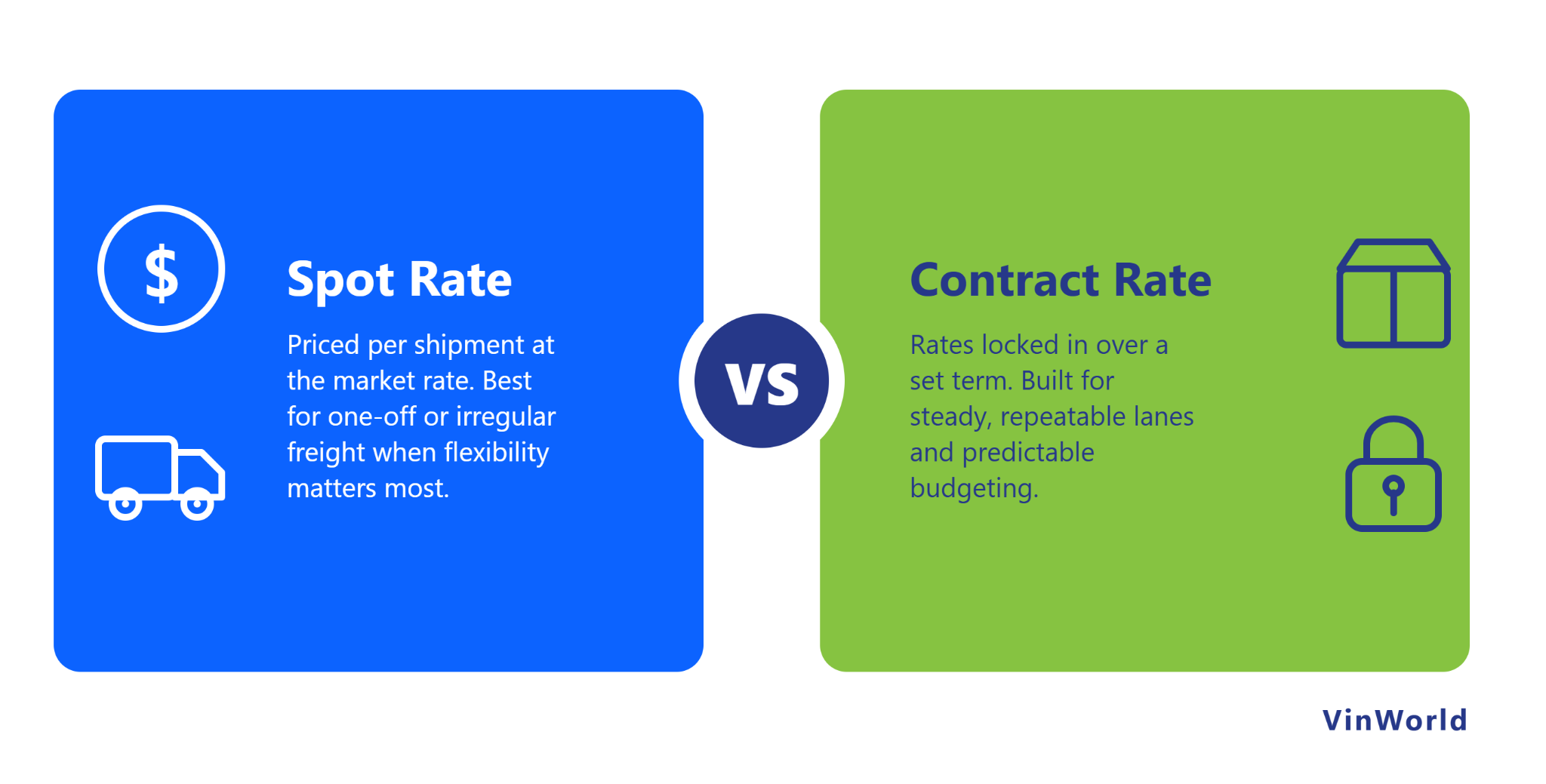
A sound freight procurement strategy rarely relies on a single pricing model. Contract and spot rates do different jobs, and most shippers blend them.
| Dimension | Contract rates | Spot rates |
|---|---|---|
| Pricing | Fixed for the contract term | Set by the market, day to day |
| Best for | Stable, predictable volume | Surges, new lanes, one-off moves |
| Main benefit | Budget certainty and committed capacity | Flexibility and speed |
| Main risk | Overpaying if the market falls | Price spikes when capacity tightens |
| Typical use | The majority of committed volume | A managed buffer for the rest |
The right split depends on how predictable your volume is and how much rate risk the business can absorb. Steady, year-round lanes lean on contracts; seasonal peaks keep more room for spot.
Procurement by Mode: Air, Ocean, and Domestic
Cost drivers and capacity vary sharply by mode, so sourcing has to be tailored to each.
Air Freight
Air freight procurement buys speed and reliability for time-sensitive cargo. Global air cargo demand reached record volumes in 2025, a reminder that speed commands a premium and space on key lanes can be scarce. Because rates and capacity move fast, air sourcing blends block-space agreements on core lanes with spot bookings for urgent or oversized shipments. A forwarder with direct airline relationships secures capacity that a one-off booking cannot.
Ocean Freight
Ocean freight procurement depends on more than the quoted container rate. The strength of the contract, the reliability of booked space, and the actual transit timeline determine whether the shipment moves predictably or becomes exposed to delays, rollovers, and added cost.
Container rates move in cycles, and the quoted price rarely tells the full story. The real cost depends on capacity, schedule reliability, surcharges, port conditions, and how much disruption the shipment can absorb.
Domestic Road
Trucking is the dominant mode in North American freight, making domestic sourcing a core discipline for U.S. shippers. It spans full truckload (FTL), less-than-truckload (LTL), and specialized equipment, plus port moves like drayage.
7 Best Practices in Freight Procurement
Strong freight brokers share a set of habits aimed at the lowest total cost and risk, not the lowest invoice line:
- Diversify your carrier base. A vetted pool of primary and backup carriers keeps freight moving when one falls short.
- Vet carriers rigorously. A structured onboarding and review process screens out at-risk carriers and protects you on insurance and compliance.
- Benchmark every bid. Compare quoted rates against market indices to spot inflated bids and negotiate from data.
- Balance contract and spot. Commit predictable volume to contracts; hold a managed buffer for the spot market.
- Match the carrier to the freight. Temperature-controlled, hazmat, and oversized loads need specialists.
- Use technology for visibility. A TMS or shipment portal turns scattered emails into trackable data. This is the foundation of freight procurement optimization.
- Treat carriers as partners. Consistent volume and prompt payment earn priority capacity when the market tightens. These relationships are easier to protect when a skilled freight forwarder manages the carrier dialogue, contract terms, and execution follow-through.
Stop Chasing Rates. Start Controlling Outcomes.
Procurement is where cost control, capacity, and service reliability are won or lost. Shippers who treat it as an ongoing, data-driven discipline – not an annual scramble – spend less, ship more predictably, and absorb disruption better than competitors chasing the lowest spot rate.
Freight procurement gets expensive when carrier selection, rate control, and shipment visibility are handled as separate decisions. VinWorld brings those pieces together with vetted carrier coordination across air, ocean, and domestic freight, supported by rigorous carrier screening, real-time visibility, and 24/7/365 operational support. Request a quote
Frequently Asked Questions
What is the difference between freight procurement and freight management?
Procurement is the sourcing side: selecting, negotiating, and contracting carriers. Management is the execution side: booking, tracking, and settling shipments once carriers are in place. Procurement decides who moves your freight; management runs it day to day.
How often should a company run a procurement event?
Most shippers re-bid their core network annually or semi-annually, then use smaller mini-bids for new lanes or sudden volume changes. Highly volatile markets may warrant more frequent reviews to keep contracted rates competitive.
Can small businesses benefit from formal freight sourcing?
Yes. Even a shipper moving twenty truckloads a month can cut costs and improve reliability by comparing carriers, securing a few contract lanes, and keeping spot options for overflow rather than booking ad hoc.
Does procurement differ for international shipments?
It does. International sourcing adds customs, documentation, incoterms, and longer lead times, and it spans air and ocean modes where carrier contracts and agent networks heavily shape both price and transit time.



Comments